 04
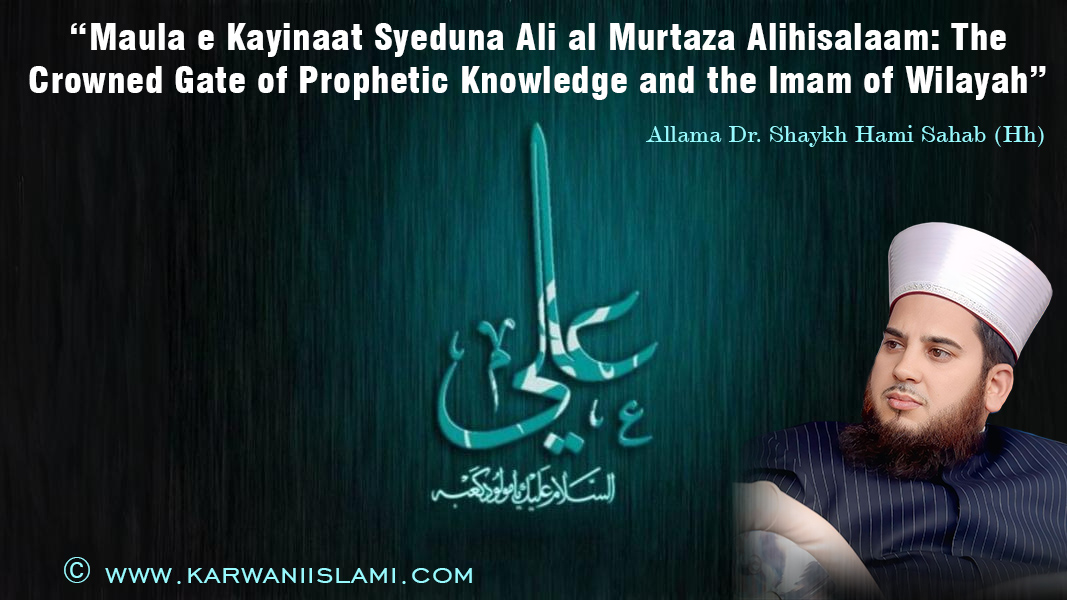
04 “Maula e Kayinaat Syeduna Ali al Murtaza Alihisalaam: The Crowned Gate of Prophetic Knowledge and the Imam of Wilayah”
Allama Dr. Shaykh Hami Sahab (Hh)
Sheikh Sameer Manzoor:
In the realm of Islamic spirituality, few names shine with the radiant brilliance of Syeduna Ali ibn Abi Talib (AlihiSalaam). Revered as Asadullah (The Lion of Allah), Al-Murtaza (The Chosen One), and Maula-e-Kainaat (The Master of the Faithful), he remains one of the most towering figures in Islam. His birth inside the Holy Kaaba symbolizes his destiny as a man of divine station and unmatched sanctity. Syeduna Ali (AS) was the son of Abu Talib and Fatimah bint Asad, from the noble lineage of Banu Hashim. He was not only the Prophet Muhammad's ﷺ cousin and son-in-law but also the first youth to embrace Islam. Raised in the prophetic household, he became the embodiment of loyalty, courage, spiritual wisdom, and deep Islamic knowledge. His early life was a reflection of total devotion to the Prophet ﷺ. When the Prophet received revelation, it was Syeduna Ali who stood beside him, unwavering. During the Hijrah, Ali took the Prophet's place in bed, risking his own life to protect the Messenger of Allah ﷺ. This noble act is captured in the verse of Surah Al-Baqarah (2:207): "And among mankind is he who sells himself, seeking the pleasure of Allah." From battles to treaties, from sermons to silent worship, Ali was the pillar upon which the early Islamic community leaned. He displayed unmatched bravery in battles such as Badr, Uhud, Khandaq, and Khaybar, earning the title of Zulfiqar's bearer—the legendary sword gifted to him by the Prophet.
In the Battle of Khandaq (the Trench), when the Qurayshi warrior Amr ibn Abd Wudd leapt across the trench, none dared to face him except Ali. With the Prophet's ﷺ permission, Syeduna Ali stepped forward and defeated the feared warrior, earning the Prophet’s praise: “The strike of Syeduna Ali on the day of Khandaq is greater than the worship of both humans and jinn until the Day of Judgment.” Likewise, in the Battle of Khaybar, Syeduna Ali stormed the fortress single-handedly, lifting a gate which seven men could not carry together. These battles symbolize not only his courage but his spiritual strength and trust in divine support. His encounters with disbelievers and heretics were marked by immense wisdom and spiritual insight. Once a group of Christians tried to trap the Prophet ﷺ in theological debates. Syeduna Ali stepped forward, refuting their claims by quoting verses from both the Qur'an and Injil. His knowledge silenced them. In another instance, when a deviant asked, “Is your Lord capable of placing the entire world in an egg without breaking it?” Syeduna Ali replied, “Yes, He who placed your soul into your body can do that and much more.” His eloquence was divine, his arguments penetrating, and his presence awe-inspiring. As Shaykh Hami states: “Syeduna Ali’s ilm (knowledge) was not learned, it was illuminated. He did not speak from intellect alone, but from the secrets inspired into his heart by the Prophet ﷺ.”
One of the most defining spiritual declarations in Islamic history was made at Ghadir Khumm, where the Prophet ﷺ held Syeduna Ali's hand and said, "Whoever considers me his master, Syeduna Ali is also his master." (Tirmidhi, Musnad Ahmad). This event, affirmed by countless scholars including Imam al-Nasa'i and Imam Suyuti, was not merely a historical proclamation, but a divine appointment of Syeduna Ali's spiritual rank. As Allama Dr. Shaykh Hami rightly states, "This was the echo of divine will. At Ghadir, the Prophet unveiled Ali's light to the world. He was not just a companion; he was the gateway through which divine knowledge and spiritual authority would continue."
Syeduna Ali's knowledge was so vast and sacred that the Prophet ﷺ said, "I am the city of knowledge, and Ali is its gate. So whoever desires knowledge must enter through the gate." (Mustadrak al-Hakim). His sermons in Nahj al-Balagha remain timeless treasures of spiritual wisdom, rhetoric, and governance. His famous call, "Ask me before you lose me," was not arrogance but a sincere offer to preserve divine truths. He would often explain intricate Qur'anic verses with spiritual depth and legal clarity. As Imam Abu Hanifa said, "Had it not been for Ali, we would have been lost in legal matters."
As a ruler, Syeduna Ali (AS) epitomized justice and humility. He ruled during a time of great political turmoil, but he never wavered from the path of truth. His letter to Malik al-Ashtar is still quoted as one of the finest documents on governance and human rights. In it, he reminds: "People are either your brothers in faith or your equals in humanity." His governance was not driven by power but by service, not by authority but by responsibility. When his brother Aqeel asked for wealth from the public treasury, Syeduna Ali lit an iron rod and brought it close to him, asking, "Can you bear this heat? If not, how will you bear the fire of Hell?"
One of the most sacred moments in the life of Syeduna Ali (AS) was when the Verse of Purification (Ayah al-Tatheer) was revealed. Allah states in Surah Al-Ahzab (33:33): "Indeed, Allah intends to remove all impurity from you, O People of the House (Ahl al-Bayt), and purify you with a thorough purification." The Prophet ﷺ gathered Ali, Fatimah, Hasan, and Husayn under his cloak and prayed, “O Allah, these are the People of my House. Remove from them all impurity and purify them completely.” This event, known as Hadith al-Kisa, is recorded in Sahih Muslim and Tirmidhi. It signifies the divine sanctification of Ali and his family. Allama Dr. Shaykh Hami powerfully notes: “When Allah purified the Ahlul Bayt, He placed Ali not outside the circle of sanctity but at its heart. He is the pillar of that purified house, the carrier of its divine fragrance.”
His role as a father, husband, and spiritual anchor is equally significant. Married to Sayyidah Fatimah al-Zahra (R.A), the daughter of the Prophet ﷺ, he raised the Imams Hasan and Husayn, the leaders of the youth of Paradise. Their home was a sanctuary of dhikr, patience, simplicity, and sacrifice. When Fatimah once asked for a maid, the Prophet instead taught them the Tasbih Fatimah—subhanAllah 33 times, alhamdulillah 33 times, Allahu Akbar 34 times—a spiritual tool more powerful than worldly aid.
Syeduna Ali’s martyrdom was as noble as his life. Struck during Fajr salah in the Masjid of Kufa by the Kharijite Ibn Muljam, his final words were, "Fuztu Bi Rabbil Ka'bah" (By the Lord of the Ka'bah, I have succeeded!). Thus ended the life of a man who lived every breath for Allah and His Messenger. Allama Dr. Shaykh Hami reflects: “Syeduna Ali did not die with the sword. He rose with martyrdom. His sajdah became his mi'raj, and his blood became ink for the lovers of truth."
Syeduna Ali's spiritual legacy endures through the ages. All Sufi paths—Qadiriyya, Chishtiyya, Naqshbandiyya, Shadhiliyya—trace their silsila through him. He is the Baab al-Wilayah (Gate of Sainthood). Shaykh Abdul Qadir Jilani (R.A) declared, "My knowledge and spiritual inheritance flow from Ali." Imam Ahmad Raza Khan (R.A) stated, "Ali is the fountain from which oceans of Wilayah emerge." Shaykh Hami beautifully summarizes: "Ali is not a chapter of the past; he is the heartbeat of spiritual Islam. His love is Iman, his hate is nifaq, and his path is the secret to nearness with Allah."
Syeduna Ali's sermons in Nahjul Balagha, a divine compilation of his speeches, letters, and maxims, form one of the most significant treasures in Islamic literature. This profound work, compiled by Sharif Razi in the 10th century, is considered a lighthouse of eloquence, governance, justice, and spiritual insight. From guidance to governors like Malik al-Ashtar to metaphysical reflections on death, destiny, and divine wisdom, Nahjul Balagha serves as a timeless constitution for both rulers and seekers. Imam Jalaluddin Suyuti referred to its eloquence as ‘beyond the reach of human imitation.’ Shaykh Hami remarks: “Nahjul Balagha is not merely a collection of Ali's words—it is a divine whisper carried through a man whose tongue never moved without the scent of revelation. Every sentence is a lantern, every sermon a sea, and every word a sword of truth.”
Let it be known that to insult or degrade Syeduna Ali (AS) is to offend the very heart of the Prophet ﷺ and the pleasure of Allah. Allah says in Surah Al-Ahzab (33:57): "Indeed, those who harm Allah and His Messenger, Allah has cursed them in this world and the Hereafter and prepared for them a humiliating punishment." The Prophet ﷺ said, “None loves Ali except a believer, and none hates him except a hypocrite.” (Sahih Muslim). In another narration, it is stated, “Only a believer loves Ali and only a disbeliever hates him.” As Shaykh Hami often emphasizes: “He who carries hate for Ali in his heart carries fire in his soul. That fire distances him not only from the Ahlul Bayt but from the Mercy of Allah itself.”
It is deeply concerning and academically dishonest when certain individuals extract Hadith 4577 from Sahih Muslim, where Syeduna Abbas (R.A) is recorded to have used strong words like “liar,” “sinner,” “betrayer,” and “deceiver” against Syeduna Ali (AS), and manipulate it to question or diminish the spiritual rank of Maula Ali Al-Murtaza (AS)—the Lion of Allah, the Gateway of Knowledge, and the purified soul among Ahlul Bayt. To weaponize this narration without understanding its context, linguistic implications, and interpretations by leading Sunni scholars, is not only a violation of scholarly ethics, but also an act that risks falling into the ranks of those whom the Prophet ﷺ warned about when he said, “Only a believer loves Ali, and only a hypocrite hates him.” (Sahih Muslim). This narration occurs in the context of an inheritance dispute following the Prophet’s ﷺ demise. Syeduna Ali and Syeduna Abbas were both claiming rights to administer the land of Fadak, which the Prophet ﷺ declared as sadaqah, not miras (inheritance). The alleged harsh words were uttered by Abbas (R.A) during a legal discussion before Syeduna Umar (R.A). However, the linguistic structure and tone of the narration, according to scholars such as Imam Nawawi, Imam al-Mazari, and Ibn Hajar al-Asqalani, indicate rhetoric, not reality. These words were spoken in the heat of debate—not as a judgment of Ali’s character. Imam Nawawi states that this was a purely legal matter, not a personal or theological accusation. Furthermore, Imam Ibn Hajar explains that these were expressions of frustration, not verified character assessments, and should not be taken as theological truths.
Allama Dr. Shaykh Hami added that the words should be understood conditionally, meaning: “If Ali is lying, then he would be…”—which clearly shows this was not an absolute judgment. Additionally, it was Abbas speaking in a moment of intensity—not the Prophet ﷺ, not a judge, and certainly not Allah. And Syeduna Umar (R.A) responds not by affirming the accusations but by recalling the Prophet’s ﷺ hadith that “We Prophets do not leave inheritance; whatever we leave is charity.” He confirms both Abu Bakr and Ali acted righteously in this matter. This alone refutes the idea that Ali (AS) committed any wrong. To use this hadith against Syeduna Ali (AS) is to ignore the overwhelming testimony from Qur’an and Sunnah in his favor. The Prophet ﷺ said, “I am the city of knowledge and Ali is its gate” (Mustadrak Hakim), and at Ghadir Khumm he proclaimed, “Whoever has me as his master, then Ali is his master too.” (Musnad Ahmad, Tirmidhi) Moreover, during the revelation of Ayah al-Tatheer (33:33), the Prophet ﷺ gathered Ali, Fatima, Hasan, and Husayn under his cloak and prayed, “O Allah, these are the People of my House. Remove impurity from them and purify them completely.” This is recorded in Sahih Muslim and Tirmidhi, and it establishes beyond doubt the divine purity of Syeduna Ali (AS).
In addition, Sunni imams like Imam Abu Hanifa, Imam Malik, and Imam Ahmad ibn Hanbal have all recognized Syeduna Ali (AS) as among the most knowledgeable and righteous of the companions. Imam Ahmad Raza Khan condemned the misuse of such narrations and declared that loving Ali is part of Iman, and those who insult him are cutting themselves off from the Mercy of Allah. As Allama Dr. Shaykh Hami eloquently says: “To dishonour Ali is to dishonour the Prophet ﷺ; to cast doubt on his trustworthiness is to insult the cloak under which Allah revealed Ayah al-Tatheer. This is not just ignorance—it is fitnah that tears the Ummah apart.”
In conclusion, Hadith 4577 must not be weaponized. It must be understood as a legal, emotional, and historically contextual interaction, not a license to degrade the personality of Syeduna Ali (AS). Doing so not only contradicts the Qur'an and Sunnah, but also aligns one with the hypocrites whom the Prophet ﷺ warned would hate Ali. This narration, in light of hadith sciences, Arabic grammar, scholarly tafsir, and the ethics of disagreement, is not a proof against Ali—rather, it is proof of the deep, complex, and sacred dynamics among the Sahaba who never lost their mutual dignity despite legal disagreements. The Ummah must approach such texts with reverence, caution, and the love of Ahlul Bayt in their hearts.
From the Qur'anic praise to the battlefield, from the sermons in the masjid to the tears of tahajjud, from his sword Zulfiqar to his nights of solitude—Ali (AS) is the most complete mirror of the Muhammadan light after the Prophet himself. He was not a man of status; he was a man of substance. He did not seek the world, the world bowed to his character. As Allama Dr. Shaykh Hami concludes: "He is Ali—the Lion of Allah, the beloved of the Prophet, the father of the Imams, the master of saints, and the mirror in which the Ummah sees the reflection of divine nobility."
May Allah grant us the love of Syeduna Ali, the courage of Syeduna Ali, the patience of Syeduna Ali, and the light of Syeduna Ali? May our tongues forever salute him, our hearts remain attached to him, and our footsteps follow his path to the gates of paradise. Ameen.
Research Scholar
Sheikh Sameer Manzoor
sheikhsameermanzoor@gmail.com
Copyright 2026 Karwani Islami. Designed By ShivaClicksoft
 English
 Deutsch
 简体中文
简体中文
 العربيّة